
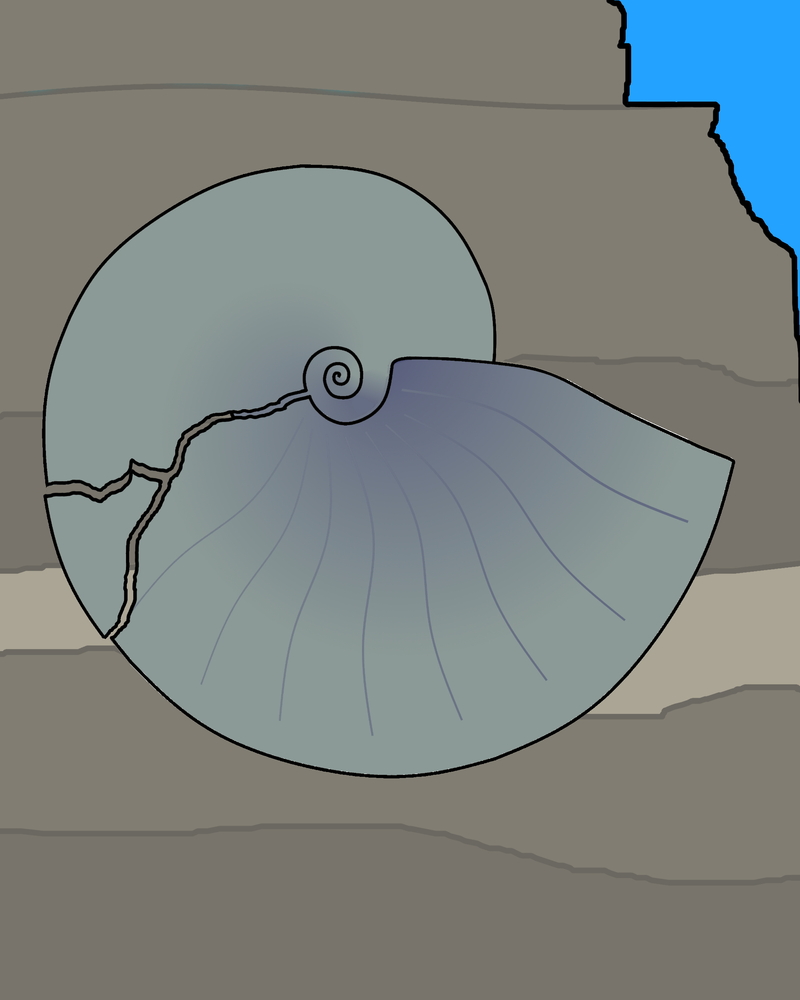
Fossils are the preserved remains of ancient living things. These remains usually have to be over 10,000 years old to be considered a fossil.
Many kinds of fossil
There are many kinds of fossil. The most common type is called Permineralization, and this is shown below. Others include Natural casts, or the imprint of an animal, Trace fossils, things left behind by animals such as footprints and dung, Amber, which sometimes holds small animals, and Preserved remains, such as animals frozen in permafrost.


The first step for any fossil to form is burial, before the living thing has time to decompose.
The second stage is for the mud, ash, sand, or other substance around the living thing to turn to rock.
The third stage is for the remnants of the living thing to be slowly turned to rock, dissolved minerals seeping through what is left of it.

The fourth step is the shifting of the rock around the fossil. This may damage the fossil, and it also will sometimes bring it to the surface, ready to be discovered.
In the past, people have had different views of what fossils were. For a long time, many people thought they were just interesting rock formations that grew naturally inside some rocks. Other people thought that they were animals and plants turned to stone, and in a way they are, as you saw above. The ancient Chinese found horse bones and thought they belonged to dragons. In ancient Europe, Belemnite (ancient cephalopods similar to squid) fossils were thought to be darts thrown down in a thunderstorm. Ammonite fossils, due to their shape, where said to be curled up, petrified snakes, called snakestones. Craftsman even carved stone heads into the fossils to sell to travelers In the 1500s, one writer thought that fossils were formed when animals were turned to stone by a special juice . In the 1600s, one writer thought that some fossils were formed when an animal’s eggs got stuck in crevices, and they hatched into stone coppies of the original animal. Today, we know fossils are the remains of ancient animals, preserved in stone.
Sources
https://australian.museum/learn/australia-over-time/fossils/how-are-fossils-formed/
https://www.bgs.ac.uk/discovering-geology/fossils-and-geological-time/belemnites/
https://markwitton-com.blogspot.com/2021/03/dinosaur-fossils-and-chinese-dragons.html
Fossils by Cyril Walker and David Ward
Life of the Past, forth edition by William I. Ausich and N. Gary Lane